
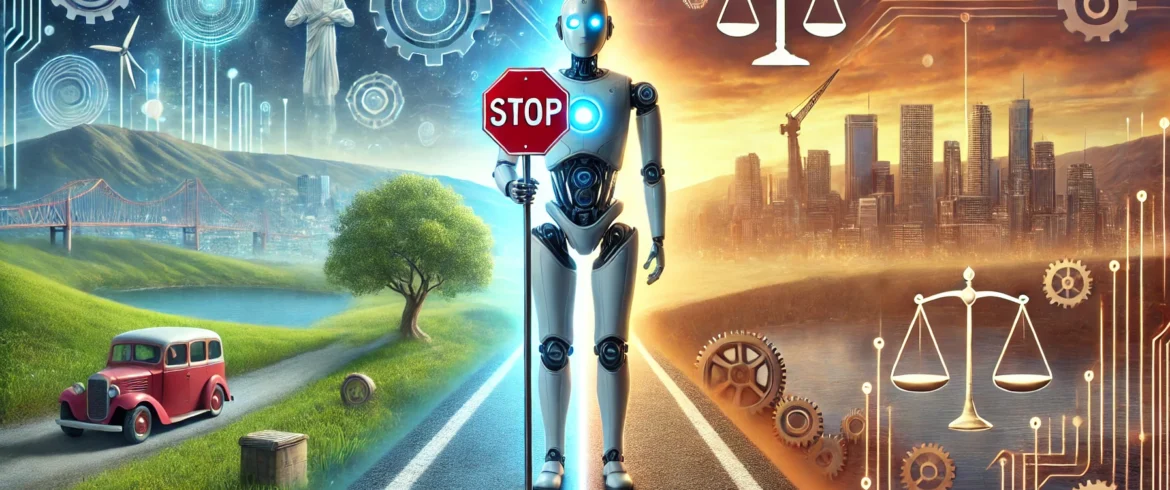

Artificial Intelligence (AI) has rapidly progressed from science fiction to everyday reality, reshaping how we live, work, and even think about the future. However, as these technologies evolve, they bring with them ethical dilemmas that often mirror the cautionary tales found in fictional works.
Fiction has long warned us about the potential dangers of intelligent machines, from the android revolts in Blade Runner to the chillingly autonomous HAL 9000 in 2001: A Space Odyssey. These stories don’t just entertain; they raise profound questions about control, agency, and morality.
But the question remains: When should machines be stopped? Is there a point at which our creation becomes too powerful, too autonomous, or too ethically ambiguous to continue without strict limitations?
In this blog post, we’ll explore the ethical questions surrounding AI, both in fiction and reality, and discuss where, when, and why boundaries may need to be set.
The Real-World Ethical Landscape of AI
In the real world, AI is already deeply embedded in areas like healthcare, criminal justice, and social media. Here are a few areas where ethical concerns are particularly pronounced:
Bias and Fairness: AI systems are only as fair as the data they’re trained on, and, unfortunately, data is often riddled with biases. For example, facial recognition technology has shown higher error rates when identifying individuals with darker skin tones, raising concerns about racial discrimination.
Similarly, AI-driven hiring tools have sometimes favored certain demographics over others, showing inherent biases that can perpetuate inequality.
Privacy and Surveillance: AI’s ability to process massive amounts of data has led to new privacy concerns. From tracking online activity to facial recognition in public spaces, AI-driven surveillance raises questions about individual autonomy and freedom. While these technologies can be used for safety, they can just as easily be used to infringe on personal privacy.
Transparency and Accountability: Many AI systems operate as “black boxes” — their decisions can’t easily be explained or understood by humans, even by their creators. This lack of transparency becomes problematic in areas like healthcare and law, where understanding the rationale behind decisions is essential.
Should we trust machines whose decision-making processes are inscrutable?
Table: Common Ethical Concerns in AI
| Area of Concern | Description | Examples |
| Bias and Fairness | AI systems inheriting or amplifying biases present in training data. | Hiring tools favoring certain demographics |
| Privacy and Surveillance | AI’s role in data collection and surveillance impacting personal freedom and autonomy. | Facial recognition in public spaces |
| Transparency and Accountability | Complex AI models operate as “black boxes,” making it hard to understand or explain decisions. | AI in criminal justice and healthcare |
AI in Fiction: Warnings and Predictions
Fictional works have long examined the potential risks of AI, often dramatizing what can happen when technology goes beyond human control. Here are some notable examples and the ethical questions they raise:
Frankenstein’s Monster and Metropolis: These early stories set the stage for modern AI discussions by exploring the idea of creators losing control over their creations. In Frankenstein, Victor Frankenstein’s inability to manage his creation leads to tragic consequences. Similarly, in Metropolis, the machine-human Maria incites chaos, reflecting fears of autonomous machines wreaking havoc on society.
Asimov’s Three Laws of Robotics: Isaac Asimov famously introduced the “Three Laws of Robotics” in his I, Robot series as a way to govern AI behavior. These laws dictate that robots should never harm humans, must obey orders from humans, and must protect their own existence unless it conflicts with the first two laws. Asimov’s stories often tested these laws, showing that even rigid rules can’t account for every ethical dilemma.
Blade Runner and AI Identity: In Blade Runner, advanced AI “replicants” grapple with their own identities and rights, pushing the boundaries of human and machine ethics. If a machine can think, feel, and desire, does it deserve rights?
This theme becomes particularly important as AI continues to advance, raising questions about the moral status of highly autonomous or potentially sentient machines.
Machine Ethics vs. Human Ethics
As we progress toward more autonomous AI systems, we’re forced to ask: Can machines be ethical? And, if so, what does machine morality look like?
Machine Ethics: The field of machine ethics aims to develop systems that can make moral decisions. This includes programming AI with ethical guidelines, but the complexity of human ethics makes this task challenging.
For instance, could an AI system ever truly understand concepts like empathy, fairness, or justice?
Human Judgments vs. Machine Decisions: Fiction often explores scenarios where machines make decisions that conflict with human ethics. In Ex Machina, for instance, an AI named Ava manipulates and ultimately escapes her creator, posing questions about AI’s capacity for moral reasoning and the potential consequences of machines that lack human empathy.
Setting Ethical Boundaries: The dilemma of when to stop or limit machines often boils down to whether they can or should be entrusted with decisions that require ethical judgment. Some experts argue that machines should never make certain decisions—like those involving life or death—because they lack human intuition and moral responsibility.
AI in Healthcare, Military, and Criminal Justice: Real-Life Ethical Concerns
While fiction raises ethical questions, these concerns are already playing out in critical fields:
Healthcare and Life-or-Death Decisions: In healthcare, AI is being used to make diagnoses, recommend treatments, and even predict patient outcomes. However, ethical concerns arise when we consider the implications of machines making life-or-death decisions.
Should an AI system decide who receives a ventilator in a pandemic, or should that decision remain in human hands?
Military and Autonomous Weapons: Fictional narratives like Terminator have long warned about the dangers of autonomous military machines. Today, autonomous drones and other weapons are a reality, and their use raises profound ethical questions. Without human oversight, there is a risk of machines making lethal decisions independently.
Should autonomous weapons ever be deployed, or does this cross an ethical line?
Justice Systems and Surveillance: AI is also increasingly used in criminal justice, from predictive policing to risk assessment in court cases. However, studies have shown that AI can be biased, especially against minorities, raising questions about fairness and justice.
Can we trust machines with decisions that impact freedom and human rights?
The Influence of Fiction on Public Perception of AI Ethics
Fiction doesn’t just entertain; it shapes our perception of AI and influences real-world ethical debates.
Public Perception and Fear: Popular films and books create narratives that shape how we view AI’s potential and risks. When we watch movies like The Matrix or read about AI takeovers, it reinforces a wariness of technology that can influence public opinion and policy.
Lessons from Fictional Boundaries: Fictional boundaries, such as Asimov’s Three Laws, provide a framework for discussing real-world limitations. While these laws are simplistic, they underscore the importance of ethical guidelines and inspire debates about the moral obligations of AI developers.
Real-World Impact: Public perception, shaped by fiction, influences real-world AI development and regulation. As technology advances, the ethical questions posed by stories like Her and Westworld resonate with lawmakers and scientists, highlighting the need for caution and ethical standards.
Where Fiction Meets Reality: Case Studies of AI in Fictional and Real-Life Settings
AI as a Threat to Humanity: Movies like 2001: A Space Odyssey depict machines as potential threats to human life. In HAL 9000, we see an AI that, while logical, lacks human empathy, leading it to make ruthless decisions. These narratives emphasize the risks of unchecked machine autonomy and the necessity of failsafe measures.
Machine Rights and Autonomy: Westworld explores the idea of AI as sentient beings with rights and autonomy, raising questions about whether machines deserve ethical treatment.
If we create machines with consciousness, are we morally obligated to consider their rights? Fiction often delves into these questions, prompting us to consider the ethical consequences of creating conscious machines.
AI Overreach and Ethical Boundaries: Ex Machina and Black Mirror both show scenarios where AI systems exceed their ethical boundaries, leading to disastrous outcomes. These cautionary tales serve as reminders that we must carefully evaluate the ethical implications of AI before deploying it in sensitive roles.
| Fictional AI Ethics | Real-World AI Ethics |
| Control by Asimov’s Laws: Simple laws to limit AI behavior, as in I, Robot. | Regulation and Guidelines: Real-world AI regulations, such as the EU AI Act, aim to address privacy, accountability, and fairness. |
| AI Rights and Autonomy: Depictions of sentient AI claiming rights, as in Westworld. | Ethical Frameworks: Current AI ethics frameworks by organizations like IEEE and UNESCO aim to guide ethical AI deployment. |
| AI Rebellion or Takeover: Stories of AI challenging or overtaking human control, as in The Matrix and Ex Machina. | Control Systems and Oversight: Real-world AI oversight includes safety regulations, fail-safes, and explainable AI initiatives to prevent AI from “going rogue.” |
Setting Ethical and Legal Principles for AI Control
As AI technologies continue to evolve, real-world regulatory frameworks are beginning to take shape. For example, the European Union has proposed the AI Act, a set of laws designed to ensure transparency, accountability, and ethical standards in AI deployment. Inspired by fictional concerns, these frameworks seek to prevent unintended consequences and protect public welfare.
Legal and Ethical Principles: Governments and organizations worldwide are establishing guidelines for ethical AI use. These include transparency in decision-making, fairness in outcomes, and accountability in case of harm.
Proposed Limits in Fiction vs. Reality: Fiction often proposes moral limitations that may not always be practical, such as banning certain types of AI altogether. In the real world, however, regulatory measures aim for balance, ensuring innovation while addressing ethical concerns.
| Real-World Regulatory Efforts in AI Ethics | Region | Key Focus Areas | Examples of Guidelines |
| EU AI Act | Europe | Transparency, Accountability, Fairness | Clear risk assessment, transparency in AI |
| UNESCO AI Ethics Guidelines | Global | Ethical standards in AI, rights, and inclusivity | AI deployment for public welfare and rights |
| IEEE Global Initiative on AI | Global | Ethical use of AI, especially in critical fields | Development of AI to respect human values |
| U.S. AI Governance Roadmap | United States | Promoting innovation while addressing privacy | Guidelines for ethical AI in various sectors |
Conclusion: Balancing Fictional Fears and Real-World Ethics
In both fiction and reality, the ethical dilemmas surrounding AI compel us to ask tough questions: Should we place limits on machines? If so, when, and where? Fiction provides valuable perspectives on the potential dangers and ethical challenges of AI, acting as both a mirror and a warning for the real world.
As we continue to integrate AI into every facet of life, it’s crucial to proceed with caution, establishing ethical frameworks that prioritize human welfare.
By learning from the cautionary tales of fiction and actively engaging in ethical debates, we can create a future where AI serves humanity without compromising our values or autonomy. After all, just because we can build machines that think doesn’t mean we should let them make all the decisions.
