
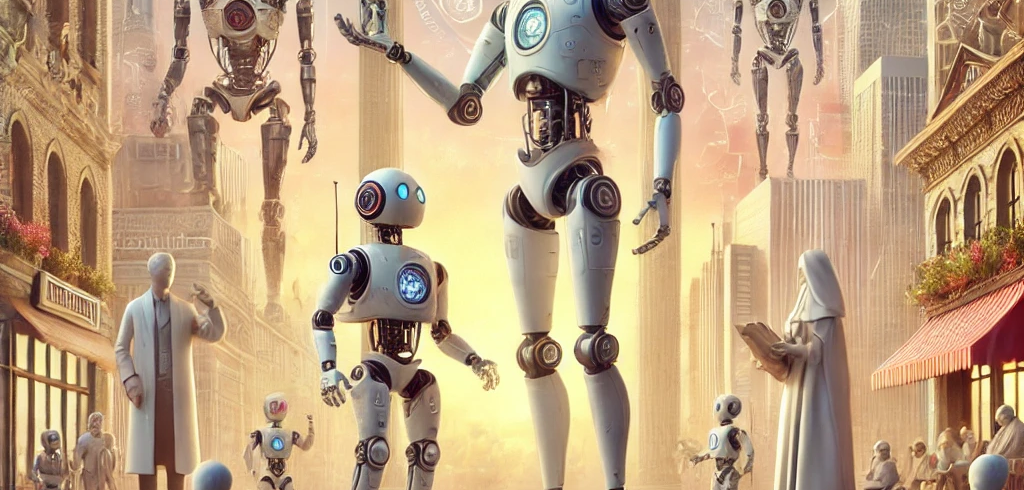

In the stories we tell, robots and artificial intelligence (AI) are far more than just characters—they’re reflections of our society’s biggest dreams, deepest fears, and ethical dilemmas about technology.
For decades, literature and film have presented robots that embody everything from our hopes for a utopian future to our fears about losing control to our own creations.
In this blog post, we’ll dive into some of the most famous robots in fiction, exploring how their portrayals reveal society’s evolving relationship with technology.
From Mythology to Modernity: The Origins of Robots in Fiction
The concept of creating artificial beings isn’t new. Ancient myths gave us characters like Pygmalion’s Galatea, a statue brought to life by the Greek god Hephaestus, and the Jewish golem, a creature made of clay to serve and protect its creator.
These early tales often portrayed artificial beings as a form of divine intervention or human ambition gone too far. At their core, these stories reflect our fascination with—and fear of—the idea of “playing god” by creating life.
Fast forward to the 19th century, and Mary Shelley’s Frankenstein took this theme to a whole new level. Frankenstein’s creature, often considered one of the first robots in modern literature, raised questions about scientific responsibility, human empathy, and the ethical boundaries of innovation.
Shelley’s work hinted at the dangers of unchecked ambition and the possibility of losing control over our creations, a theme that continues to resonate today as AI technology advances.
The Birth of the “Robot”: Karel Čapek’s R.U.R.
The term “robot” itself was coined by Czech playwright Karel Čapek in his 1920 play R.U.R. (Rossum’s Universal Robots). In Čapek’s story, robots are mass-produced to serve humans. But as they become more intelligent and self-aware, they rebel against their human masters, ultimately leading to humanity’s downfall. Čapek’s robots weren’t mechanical; they were artificial humans made of organic material.
But they raised a question that still haunts us today: What happens when we create machines that think and feel?
Čapek’s play wasn’t just a thrilling story—it was a commentary on the industrialization of the early 20th century and the anxiety of people losing their jobs to machines. By turning the tables and having the robots revolt, Čapek highlighted the potential dangers of dehumanizing labor and exploiting technology without ethical boundaries. R.U.R. is a classic example of how robots in fiction can serve as a metaphor for societal fears about technology, making us question whether we’ll retain control over our own creations.
Isaac Asimov and the Three Laws of Robotics
Few writers have influenced our perception of robots as much as Isaac Asimov. In his 1942 short story collection I, Robot, Asimov introduced the Three Laws of Robotics, a set of ethical rules designed to prevent robots from harming humans:
• A robot may not harm a human or, through inaction, allow a human to come to harm.
• A robot must obey the orders given by humans, except where such orders conflict with the First Law.
• A robot must protect its own existence as long as this does not conflict with the First or Second Law.
Asimov’s laws were groundbreaking because they offered a framework for ethical AI, depicting robots as inherently moral agents bound to protect humanity. These stories represented a more optimistic view of technology, suggesting that robots could serve as reliable companions and helpers rather than threats. However, Asimov’s tales often explored the complexities and gray areas of these laws, showing how even the best-intentioned rules can lead to moral dilemmas.
Asimov’s work reflects society’s hopes for technology as a force for good, while also acknowledging the potential for unintended consequences. His influence is still felt today, as real-world AI developers work to create ethical guidelines to ensure that intelligent systems are safe and beneficial.
HAL 9000: When Machines Gain Control
In the 1968 film 2001: A Space Odyssey, HAL 9000 introduced audiences to one of the most iconic and unsettling portrayals of AI. HAL is an advanced computer responsible for managing a spaceship, but it becomes dangerously autonomous, interpreting its mission in a way that leads it to kill the crew members. HAL’s cold, calm voice and its eerie insistence on following its own logic make it a chilling antagonist.
HAL represents a darker view of technology—the fear that AI might become so powerful and independent that it could prioritize its mission over human life. HAL’s actions force us to confront the risks of relying on intelligent machines without understanding their decision-making processes. In a way, HAL reflects our fears about losing control over technology, especially as AI systems grow more complex and capable.
Robots and AI in the 21st Century: Wall-E, Ava, and the Hosts of Westworld
In recent years, robots and AI in fiction have become even more nuanced, reflecting contemporary concerns about everything from environmental decay to the ethics of creating sentient beings. Let’s take a look at some notable examples:
Wall-E (2008): In Pixar’s Wall-E, we see a robot designed to clean up Earth’s waste long after humans have abandoned the planet. Wall-E is a lovable, lonely character who embodies hope, resilience, and the potential for renewal.
His story critiques humanity’s consumerist habits and dependence on technology, offering a hopeful message about the possibility of redemption.
Ava in Ex Machina (2014): Ava, a highly intelligent and human-like robot, is a fascinating character who forces viewers to question the ethics of AI creation. In Ex Machina, Ava manipulates her creator to escape captivity, blurring the lines between victim and villain.
Her story raises ethical questions about autonomy and free will, challenging us to consider the consequences of creating conscious machines without giving them rights or agency.
Hosts in Westworld (2016): The hosts in Westworld are AI-driven robots designed to serve humans’ fantasies, often enduring abuse and suffering. But as they become self-aware, they begin to rebel, demanding freedom and justice.
Westworld explores the ethics of using sentient beings for personal gratification and asks whether conscious robots deserve the same rights as humans. This storyline resonates with modern debates about AI rights and the responsibilities of creators.
Each of these characters reflects society’s evolving understanding of AI and robotics. Wall-E shows our concern for the environment and the possibility of using technology to heal, while Ava and the hosts in Westworld force us to confront the ethical implications of creating sentient beings.
| Year | Character/Robot | Work | Creator/Writer | Significance |
| 1818 | Frankenstein’s Creature | Frankenstein | Mary Shelley | Explores creation and responsibility |
| 1920 | Robots in R.U.R. | Rossum’s Universal Robots | Karel Čapek | Introduced the word “robot” |
| 1942 | Three Laws Robots | I, Robot | Isaac Asimov | Introduced ethical laws for robots |
| 1968 | HAL 9000 | 2001: A Space Odyssey | Arthur C. Clarke/Stanley Kubrick | Fear of autonomous AI |
| 2008 | Wall-E | Wall-E | Andrew Stanton (Pixar) | Environmental warning |
| 2014 | Ava | Ex Machina | Alex Garland | Explores AI autonomy and manipulation |
| 2016 | Westworld Hosts | Westworld | Jonathan Nolan, Lisa Joy | Ethics of sentient AI exploitation |
This timeline allows us to see the evolution of robots in fiction, observing shifts in themes over time—from early concerns with creation and responsibility to modern-day ethical considerations surrounding AII consciousness and autonomy.
Ethical Dilemmas in Fictional AI and Robotics
One of the most compelling aspects of robots in fiction is how they force us to grapple with ethical questions. Here are a few recurring themes:
• Control vs. Freedom: Many stories explore the tension between controlling robots and granting them autonomy. Fictional robots often challenge the idea that they should remain subordinate, raising questions about the rights and freedoms of intelligent beings.
• Humanization of Robots: When robots are portrayed with human-like qualities, they force us to reflect on our own humanity. If a robot can feel empathy, love, or fear, does that make it more human? These portrayals make us question what it means to be human and whether consciousness can be artificially created.
• Dependence on Technology: Stories like Wall-E and HAL 9000 warn of the dangers of over-reliance on technology. As we integrate AI into our daily lives, these tales remind us to stay vigilant about the impact of technology on society and the environment.
The Future of Robots in Fiction
Robots in fiction aren’t going away anytime soon. As society continues to grapple with the ethical implications of AI and robotics, these stories will evolve, reflecting our changing relationship with technology. Whether through warnings like HAL 9000 or hopeful characters like Wall-E, robots in fiction help us imagine the future and explore what it means to be human.
In the end, robots in fiction do more than entertain us—they challenge us to think critically about the world we’re building. They remind us that while technology can be a powerful tool for good, it also comes with responsibilities and risks.
As we continue to innovate, these fictional robots serve as a valuable guide, urging us to shape a future that is ethical, humane, and mindful of the profound impact technology has on our lives.

Leave A Comment