
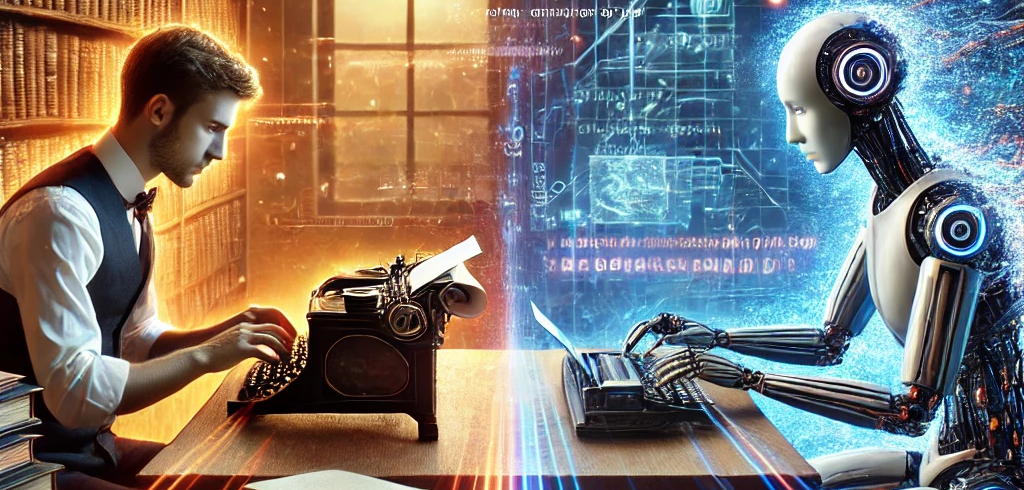

Imagine a world where your favorite novel was written by a machine. Would it feel the same?
As artificial intelligence rapidly advances, we’re entering an era where machines aren’t just processing data or performing calculations—they’re creating. AI tools like OpenAI’s ChatGPT and DALL-E are writing poetry, generating art, and even helping to script stories.
With these technological leaps, a compelling question arises: Can AI truly be creative? And if so, how does this machine-driven creativity stack up against the raw, emotional imagination of humans?
In this blog, we’ll explore the key differences between AI and human creativity, backed by studies, expert insights, and real-world examples of AI in creative roles.
Understanding Creativity: Human vs. Machine
To tackle the idea of AI creativity, let’s first define what creativity actually is. According to Oxford’s definition, creativity is “the use of imagination or original ideas to create something.” In humans, creativity encompasses far more than just assembling facts; it’s a process infused with purpose, emotion, and personal experience. As Forbes contributor Bernard Marr puts it, imagination is “the faculty we associate with our ability to have new ideas”.
While humans draw from memories, emotions, and personal beliefs to create works that resonate with others on a deeply emotional level, AI operates on a purely mechanical basis—it processes data and predicts outcomes based on statistical patterns.
Does this mean it can’t be creative? Or is it creative in a different way?
How Generative AI Works
Generative AI tools like ChatGPT and DALL-E have revolutionized how machines “create” by using machine learning algorithms trained on massive datasets. Let’s break down how they operate:
ChatGPT: Developed by OpenAI, GPT-4 (the model behind ChatGPT) is trained on vast amounts of text data to understand and generate human-like language. It works by making nuanced predictions about language, based on patterns it has seen in training
([OpenAI, 2023]
DALL-E: This tool generates images based on text prompts, using data on composition, color, and themes from millions of images. DALL-E can produce unique images by reassembling elements from its training data in creative ways. ([OpenAI, DALL-E]
In simple terms, these AI tools can mimic aspects of human creativity by identifying patterns in the data they’re trained on. When given a prompt, they don’t “imagine” a result; they calculate the most statistically likely response. While this can look like creativity, it’s more of an imitation of it.
Human Creativity vs. AI Creativity: Key Differences
To better understand the unique qualities of human and AI creativity, let’s break down a few core aspects.
| Aspect | Human Creativity | AI Creativity |
| Source of Ideas | Drawn from personal experiences, emotions, and imagination | Generated from data patterns and probabilities |
| Process | Organic, often subconscious, and influenced by emotions | Algorithmic, driven by statistical modeling and training data |
| Originality | Shaped by individual life experiences, often highly unique | Limited to remixing existing data with probabilistic variations |
| Emotional Connection | Naturally empathetic, can deeply connect with human emotions | Lacks empathy; mimics tone but has no real emotional understanding |
In essence, AI “creativity” is more about replication and recombination than true invention. It’s essential to remember that, while AI can simulate empathy in words, it doesn’t truly “feel.” A human’s poem about grief resonates because it comes from real experience, not calculated probabilities.This distinction highlights the limitations of machine learning models in reaching genuine creative depth.
Can AI Truly Have New Ideas?
One of the biggest questions in this debate is whether AI can generate genuinely new ideas. Human creativity often involves “connecting the dots” between seemingly unrelated concepts. As Steve Jobs once observed, creativity is simply “connecting things” in novel ways
Humans do this by drawing from a web of memories, emotions, and unique perspectives. In contrast, AI connects words and images based solely on its training data.
In a 2021 study conducted by researchers at Stanford University, it was found that AI lacks the experiential basis that defines human insight. The study noted that while AI can simulate “creativity” by combining data points in novel ways, it doesn’t generate ideas independently. AI’s lack of personal experience limits its ability to produce truly original, groundbreaking work.
The Illusion of AI Creativity
AI creativity is, in truth, an illusion. As Bernard Marr explains, AI’s “creativity” is best understood as a digital reflection of human input. AI produces impressive results, yet it’s bound by its programming and data—it can only remix the creative outputs of others, not produce new insights or emotions.
Example: AI-Generated Poetry
Consider the following haiku generated by ChatGPT on the topic of sunrise:
> Golden orb ascends,
> Warmth embraces earth below,
> Life awakes with light.
This haiku demonstrates ChatGPT’s ability to understand poetic structure and imagery. However, the algorithm has no personal connection to the concept of sunrise. It’s merely selecting words based on probabilities. Human poets, on the other hand, might draw on their own experiences, the emotions evoked by sunrise, or even the cultural significance attached to it, giving their writing a unique resonance.
How AI is Shaping the Definition of Creativity
As AI continues to evolve, it’s possible our definition of creativity will also shift. Just as photography was once considered merely technical before being recognized as an art form, we may one day accept AI-driven art and writing as genuine creativity. Marr suggests that the true test of AI’s creative impact will come when it begins to inspire new forms of human expression. In this sense, AI might push humans to explore areas of creativity that machines cannot touch.
Projection: Human vs. AI Content Creation
To illustrate the increasing role of AI in creative industries, here’s a projection of AI-driven content’s growth in fields like publishing, marketing, and entertainment.
| Year | Human-Created Content (%) | AI-Created Content (%) |
| 2020 | 98% | 5% |
| 2023 | 85% | 15% |
| 2025 (est) | 70% | 30% |
| 2030 (est) | 50% | 50% |
This data from a recent report by Gartner suggests that as AI tools grow more sophisticated, they will occupy an increasing share of creative roles, especially in high-volume fields like marketing and content creation.
The Value of AI in Creative Collaboration
While AI may not yet match the depth of human creativity, it can be a valuable collaborator in the creative process. For instance, writers use tools like ChatGPT to generate ideas, develop outlines, or even create drafts that can then be refined with a personal touch. Similarly, artists are using DALL-E to brainstorm visual concepts, saving time and enhancing creative output.
AI’s contributions might best be seen as a springboard—an efficient assistant that frees up humans to focus on the emotional and experiential aspects of creativity. This partnership allows humans to push boundaries and explore creative spaces that might have been previously inaccessible.
The Future of AI and Human Creativity
So, can machines really write? In one sense, yes—AI can generate coherent, beautiful, even thought-provoking content. Yet, when it comes to creating with heart, with soul, and with the richness of lived experience, AI cannot replace what makes human creativity so compelling. Ultimately, AI’s creativity may inspire us to push our boundaries, exploring forms of art and expression that machines will never truly understand.
As we move forward, AI may become a trusted partner in the creative process rather than a replacement for human imagination. The true value of AI’s “creativity” might lie in its ability to inspire us, challenging humans to push the boundaries of art, writing, and expression in ways that go beyond machine learning.
Question: What’s your take on this debate? Do you think AI could ever match the depth of human creativity?
