

The world of creative writing has been around for centuries, filled with tales that inspire, entertain, and sometimes haunt us. But recently, a new player has entered the literary stage: AI-generated stories.
Yes, artificial intelligence, once confined to data crunching and automated processes, has now set foot in the world of imagination and creativity. But can a machine truly tell a story that resonates with human emotions, depth, and complexity?
Let’s dive into this fascinating frontier and see if AI-generated stories are ready to stand toe-to-toe with human-created narratives.
The Rise of AI in Creative Storytelling
The use of artificial intelligence in storytelling is no longer science fiction; it’s happening right now. With advancements in natural language processing and machine learning models like OpenAI’s GPT series, AI can now create coherent, structured, and sometimes even emotionally engaging stories. AI can generate a full story, complete with characters, dialogue, and plot twists, within minutes.
AI story generators like ChatGPT, Jasper, and Rytr are increasingly popular. These tools don’t just spit out generic text; they can write in various styles, genres, and even mimic well-known authors’ tones. This rise of AI in storytelling isn’t just for experimental or novelty purposes—many are now seeing AI as a potential collaborator in creative work, helping human writers with brainstorming, drafting, and generating ideas.
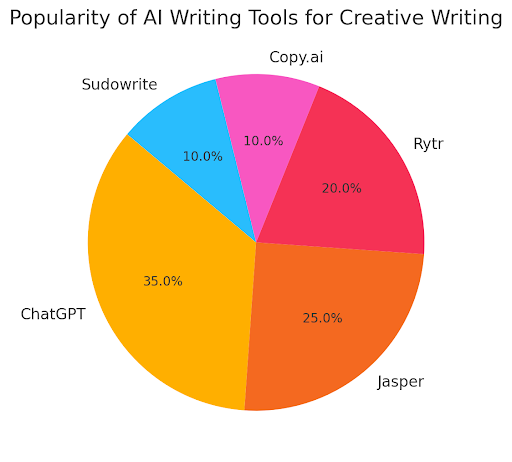
This pie chart showcasing the popularity of various AI tools (e.g., ChatGPT, Jasper, Rytr) in creative writing based on hypothetical usage data.
How Do AI-Generated Stories Actually Work?
To understand AI’s storytelling abilities, it’s helpful to know a bit about how these systems work. AI models are trained on vast datasets of text—everything from novels and news articles to poetry and blog posts. They learn patterns in sentence structure, vocabulary, and even narrative arcs. By processing these patterns, AI can generate text that “sounds” human.
When you prompt an AI with a sentence like “Once upon a time in a dark forest…,” the model doesn’t just randomly generate words. It uses its training data to predict what should come next, crafting a narrative based on the common structures it has learned. In a sense, AI is remixing learned data to create something that feels new but is rooted in pre-existing knowledge.
AI vs. Human Storytelling: A Creative Comparison
The big question everyone wants answered: Can AI-generated stories match the creativity of human-written narratives? Let’s break it down into some core aspects of storytelling.
Creativity and Originality:
AI can generate original stories in the sense that each narrative is unique, a product of the particular input and randomization of the model. However, true creativity—drawing from personal experiences, emotions, and abstract thinking—still heavily leans in favor of human writers.
Humans write from lived experiences, societal influences, and a sense of purpose that is deeply personal. AI, on the other hand, writes from patterns. This makes AI’s creativity somewhat surface-level compared to the depth a human can provide.
Complexity and Depth:
A significant aspect of powerful storytelling is the depth of characters, the nuanced themes, and the subtext that adds layers to a story. AI-generated narratives often lack this complexity. For instance, an AI might craft a technically sound story, but it struggles with the subtlety that makes a narrative resonate on a deeper level.
A story about loss, crafted by an AI, may cover the basics—characters feeling sad, facing challenges, and overcoming them. However, it misses the intricate emotions and internal conflicts that a human writer, who has personally experienced loss, might include.
Emotional Connection:
A lot of the emotional power of a story comes from the writer’s ability to infuse personal insights and empathetic understanding into their characters and plot. AI lacks true empathy—it can mimic emotion through learned language but doesn’t genuinely feel or understand it. As a result, AI-generated stories can sometimes feel flat or formulaic, lacking the emotional “heart” that resonates with readers.
AI vs Human Storytelling Comparison
| Aspect | AI Storytelling | Human Storytelling |
| Creativity and Originality | Limited originality; creates based on learned patterns | Unique creativity from personal experiences |
| Complexity and Depth | Basic structures without nuanced layers | Complex and layered narratives |
| Emotional Connection | Emulates emotions but lacks genuine empathy | Deep, genuine emotional connections |
| Writing Speed | Very fast, can generate stories in seconds | Slower, time-consuming process |
| Consistency | High, consistent quality based on input patterns | Varies, influenced by writer’s mood and experience |
Some AI-Generated Stories That Stood Out
Despite these limitations, some AI-generated stories have managed to impress readers and even make them question if a human wrote them. For example, a few AI-written short stories, generated by GPT-3, have been published on various platforms, receiving both praise and intrigue.
In an experiment by author Mark Lawrence comparing AI-written and human-written stories, readers were asked to distinguish between AI-written and human-written short stories. Surprisingly, many people couldn’t tell the difference. These experiments highlight that, under certain conditions, AI can produce stories that are engaging and enjoyable to read. For shorter works or stories that rely on humor, satire, or plot twists, AI-generated content can be quite compelling.
Some AI tools even allow for collaboration, where a human writer starts the story and AI fills in the gaps or offers suggestions. This combination of human creativity and AI efficiency has led to stories that are both imaginative and structurally sound, creating a new form of storytelling partnership.
Challenges and Limitations of AI-Generated Stories
While AI is advancing quickly, there are still some significant hurdles to overcome.
Legal and Ethical Concerns:
AI-generated content has stirred up ethical questions about originality and authorship. Since AI models are trained on existing content, some fear that AI might unintentionally replicate copyrighted material. There’s also a question of ownership: if a story is generated by an AI, who owns the copyright?
Additionally, some worry about the potential for “soulless” writing. If AI is generating entire books, are we losing the depth and purpose that comes with a human writer’s intentional choices?
Technological Limitations:
AI models have a long way to go in fully understanding context, nuance, and abstract thought. Current AI systems lack the ability to grasp the full range of human experiences, which limits their ability to generate authentic, thought-provoking narratives. As a result, while AI can produce coherent and entertaining stories, it often fails to deliver narratives that are richly layered or philosophically challenging.
Emotional Resonance:
Perhaps the biggest challenge AI faces is creating emotionally resonant stories. A machine cannot genuinely understand feelings like love, grief, or longing. Thus, while AI might be able to “describe” these emotions, it doesn’t understand them in the same way a human does. This leads to stories that can feel somewhat hollow when read carefully.
The Future of AI in Creative Writing
So, where does AI-generated storytelling go from here? The future could hold some exciting developments:
AI as a Writing Assistant, Not a Replacement:
Many believe that AI is best used as a tool to assist human writers rather than replace them. AI can be invaluable for brainstorming, drafting, and generating ideas quickly. This allows human writers to focus on refining the narrative, adding depth, and ensuring emotional impact.
Hybrid Storytelling Models:
Imagine a world where stories are co-written by humans and AI. In this model, AI might handle plot structuring, character development, or scene descriptions, while a human writer adds emotional depth and complex themes. This approach could allow writers to produce high-quality stories more quickly, blending the strengths of AI and human creativity.
Continued Technological Growth:
As natural language processing technology advances, AI’s ability to understand and generate complex narratives will only improve. While AI may never fully replicate the human touch in storytelling, it will likely get closer to producing stories that are nearly indistinguishable from human-written works.
Can AI Stories Match Human Creativity?
AI has undoubtedly entered the creative arena in a big way, and its storytelling abilities are impressive. For short stories, lighthearted fiction, and idea generation, AI-generated stories hold real value. But when it comes to emotional resonance, originality, and layered storytelling, humans still have the edge.
AI in storytelling is a powerful tool—a new frontier that’s transforming creative writing. Rather than viewing AI as a competitor, perhaps writers can see it as an ally, helping bring more ideas to life and pushing the boundaries of what stories can achieve.
As we continue exploring this frontier, one thing is clear: the future of storytelling will be richer, more diverse, and possibly more collaborative than ever before.

Leave A Comment