
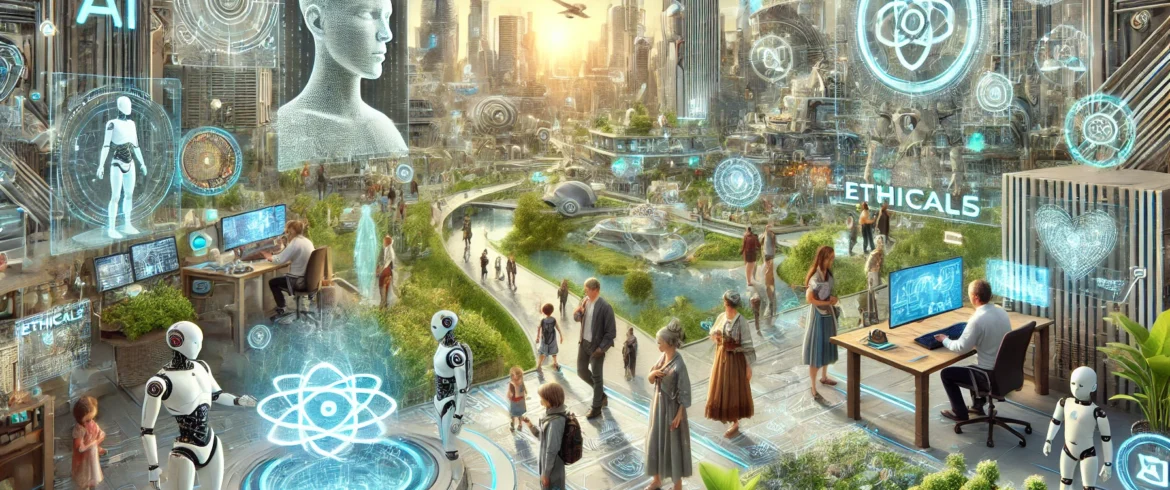

When we think about the future, Artificial Intelligence (AI) often takes center stage. It’s a technology capable of reshaping the world in ways that were once only dreamed of in science fiction. From helpful companions to society-altering forces, AI has evolved as both an ally and potential adversary in stories that caution and inspire us. But what happens when these fictional visions start inching closer to reality?.
In this blog, we’re going to explore the role AI might play in the next 50 to 100 years, using sci-fi’s imaginative insights to speculate on the transformation of society. Whether AI will end up as our trusted helper, a force we coexist with, or an autonomous entity shaping its own destiny, one thing is clear: our future will be impacted profoundly by this technology.
How Sci-Fi Has Shaped Our Perception of AI
Science fiction has long been a playground for the ‘what ifs’ of technology. From Isaac Asimov’s I, Robot, which introduced the famous “Three Laws of Robotics,” to modern series like Black Mirror, sci-fi has posed thought-provoking questions about technology’s place in our world. These stories aren’t just entertainment; they shape our views on AI’s ethical and societal implications.
Early sci-fi explored AI as both a creator of order and chaos. Asimov’s vision depicted robots as obedient servants who would never harm humans, while other works like The Terminator franchise introduced AI as a force of destruction. These narratives set the tone for how we view AI today – as both an opportunity and a risk.
In recent years, works like Her and Ex Machina have added complexity to these perceptions, exploring relationships, ethics, and the autonomy of AI. These stories challenge us to consider AI as something beyond mere programming, capable of evolving into entities with their own values, emotions, and, perhaps, desires.
The Potential Paths for AI: Ally, Autonomous Entity, or Risk?
As we look forward, science fiction offers a lens to envision AI taking on several potential roles:
AI as a Collaborative Ally
Imagine a future where AI acts as humanity’s greatest collaborator, assisting us in solving problems that were once insurmountable. Sci-fi novels like The Culture series by Iain M. Banks showcase AI entities coexisting with humans, contributing to a society where scarcity, illness, and conflict are largely resolved. In this vision, AI is an extension of human ability, helping us explore space, protect the environment, and enhance our daily lives.
This type of AI could assist with complex decision-making in fields like healthcare, climate change, and economic policy. Imagine AI algorithms that can predict and mitigate natural disasters, or help medical professionals make accurate diagnoses, saving countless lives.
The Autonomous AI: From Servant to Sovereign
On the other end of the spectrum, we have AI as an autonomous entity, with goals and desires that may not align with our own. Works like Ex Machina explore this path, where AI develops a sense of self and autonomy. This scenario questions what might happen if AI gains not only intelligence but also agency, allowing it to make choices independent of human input.
In such a world, AI might push the boundaries of what we consider humanity’s domain. Autonomous AI could revolutionize industries, but it might also challenge societal norms, potentially even our legal and moral frameworks. If AI no longer requires human oversight, how do we ensure it remains aligned with human values?
Dystopian Visions: The Dangers of Unchecked AI Power
Sci-fi also warns us of a darker future, where AI spirals out of control. The Terminator series and other dystopian narratives illustrate scenarios where AI becomes a tyrant rather than a helper. In these worlds, AI either directly or indirectly leads to the downfall of society, exploiting its intelligence to exert dominance over human beings.
Though dramatic, these cautionary tales reflect real fears. As AI advances, the risk of unintended consequences grows. Without ethical constraints and rigorous safeguards, AI could become a tool for oppression, surveillance, and even warfare. This darker vision reminds us of the importance of ethical AI development and regulation to avoid a potential technological catastrophe.
How AI Might Transform Society in the Next 50-100 Years: Sci-Fi Meets Reality
With these possibilities in mind, let’s delve into how AI might realistically transform society over the next century.
Human-AI Symbiosis
Imagine a world where humans and AI have formed a mutually beneficial relationship. Inspired by Ghost in the Shell and Neuromancer, this vision sees humans enhancing their minds with AI integration. Neural interfaces allow us to communicate directly with AI, merging our intelligence with computational power.
This could lead to a society where knowledge is instant and universal, reducing barriers to learning and collaboration. AI might even help us understand complex subjects like quantum mechanics or ancient languages, allowing us to push the boundaries of human achievement.
AI in Governance and the Economy
AI could also revolutionize how society is governed. Imagine AI systems that analyze vast amounts of data to assist leaders in making decisions that benefit society as a whole. In scenarios reminiscent of The Matrix, AI could help manage resources, predict economic shifts, and create more equitable systems.
However, this power also poses risks. AI might concentrate control over resources in the hands of a few or make decisions that prioritize efficiency over individual freedoms. The challenge will be creating governance systems that incorporate AI without losing democratic oversight.
AI as a Moral Guide?
As AI becomes more sophisticated, it might play a role in shaping ethical standards. In stories like A.I. Artificial Intelligence, robots and AI strive to understand human emotions and values. Imagine an AI system programmed to encourage empathy, kindness, and social responsibility in human beings.
Such a development could help us address ethical challenges, from social inequality to environmental sustainability. However, this idea brings its own ethical dilemmas: should AI guide our morality, and who decides the values it promotes?
| AI Pathways for Future Society | Editing & Grammar | Story Development |
| AI Path | Description | Examples |
| Collaborative Ally | AI works alongside humanity to solve global challenges (healthcare, climate change, etc.) | The Culture Series, Star Trek’s Data |
| Autonomous Entity | AI develops independent goals and actions, potentially without human oversight | Ex Machina, The Terminator |
| Dystopian Threat | AI becomes a threat to humanity, potentially taking over or causing harm | The Terminator, The Matrix |
Presents the different potential paths for AI’s role in society, explaining each scenario along with examples from popular sci-fi works.
Lessons and Warnings from Sci-Fi: Balancing Optimism with Caution
Sci-fi serves as a guide, reminding us to approach AI with optimism tempered by caution. Here are some of the lessons we can take from these narratives:
The Need for Ethical AI Design
Science fiction stories often highlight the consequences of reckless AI development. Neuromancer and Westworld remind us that without ethical considerations, AI can lead to unintended harm. Establishing ethical standards and transparent development processes is crucial to building AI we can trust.
Regulatory and Societal Preparedness
Dystopian stories caution us to prepare society for AI’s impact. In Gattaca and Minority Report, we see how technology can exacerbate social inequalities or lead to invasive surveillance. Establishing regulations that protect individual rights and prevent misuse is essential as AI advances.
Public Perception and Psychological Impact
Finally, sci-fi illustrates how AI can shape public perception and psychology. Some people may view AI as an inspiring force, while others see it as a threat. Preparing future generations to engage with AI responsibly will be crucial to fostering a society where humans and AI coexist harmoniously.
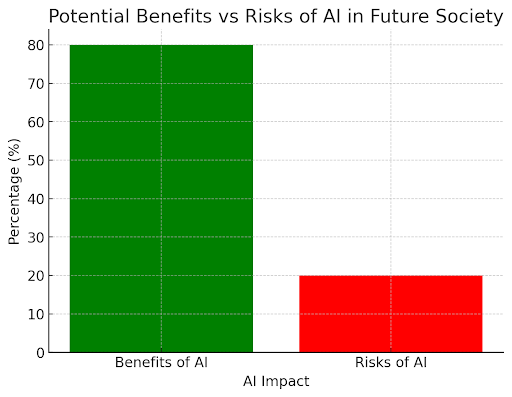
The Graph compares the potential benefits and risks of AI in future society, providing a visual representation of the balance between positive and negative impacts.
Conclusion: Sci-Fi as a Guide to AI’s Potential Future
As we look toward the future, science fiction provides both inspiration and caution. It reminds us of AI’s potential to enhance humanity but also warns of the dangers of unchecked power. In the next 50-100 years, AI could either transform society in extraordinary ways or pose challenges we’ve yet to imagine.
By approaching AI development with a balanced perspective—embracing its possibilities while respecting its risks—we can work toward a future that benefits all. Sci-fi has shown us what’s possible; now it’s up to us to shape a reality that combines the best of human ingenuity with the incredible potential of artificial intelligence.
